
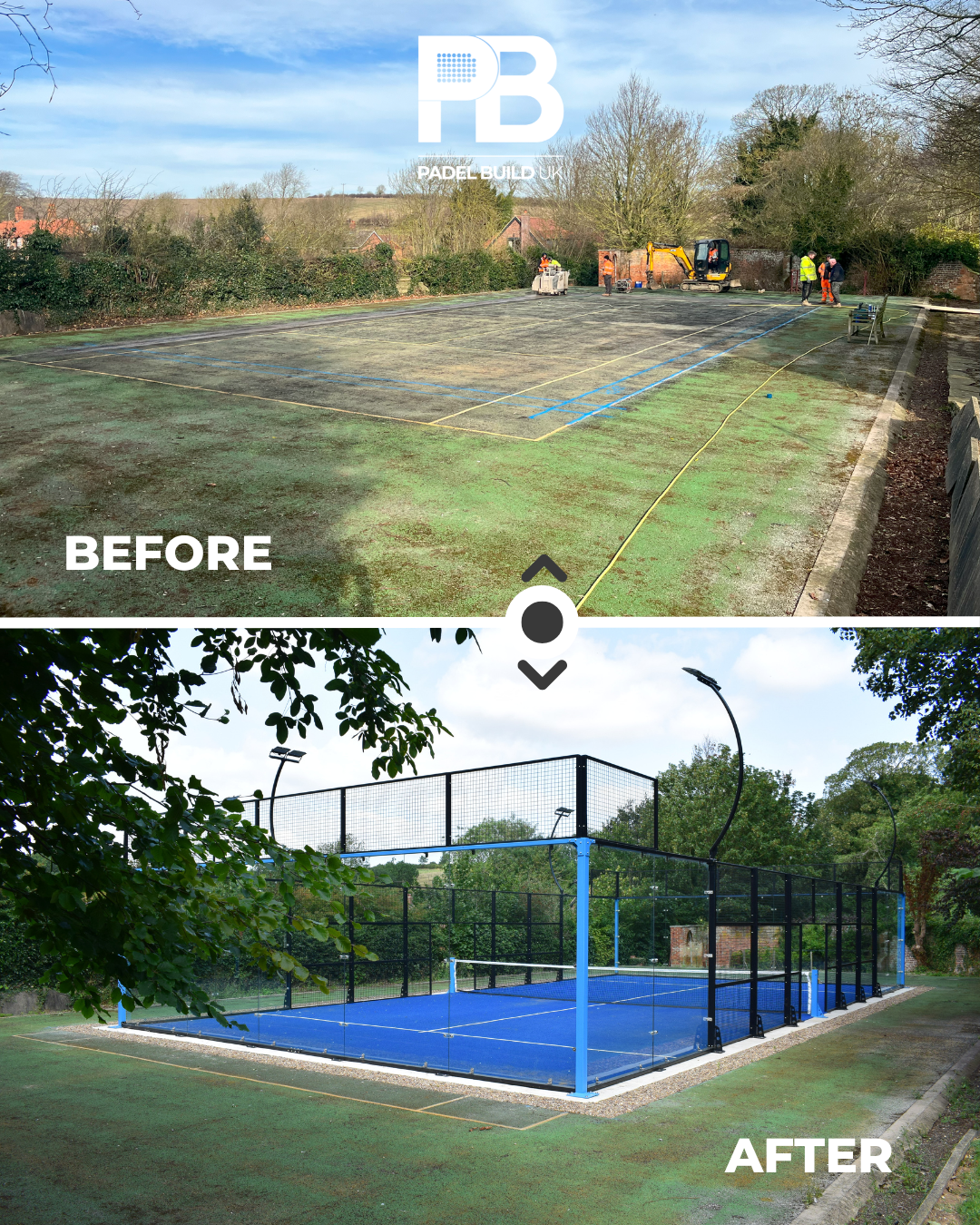
Converting an existing tennis court to padel can be one of the most cost-effective routes into the sport. With careful planning, an underused tennis facility can be transformed into a productive padel venue at a fraction of the cost of a new build.
Why convert?
Many UK sports clubs and leisure facilities have tennis courts that are underused for much of the week. A standard padel court requires a playing footprint of 20m × 10m, with an additional 1m clearance around the perimeter typically providing sufficient space for safe access and maintenance. This relatively compact footprint means that a single padel court can often be accommodated within the footprint of an existing tennis court, making conversion an attractive option for clubs looking to increase participation and revenue.
The result is a modern, high-demand facility capable of accommodating up to four players at a time, delivering significantly higher utilisation rates and more frequent bookings than many traditional recreational spaces.
The commercial case is equally compelling. A well-positioned padel court can generate strong and consistent revenue through court hire, coaching programmes, leagues, and social events. With growing demand across the UK, many operators achieve a return on investment within 12 to 24 months, depending on location, pricing strategy, and court occupancy.
What can be reused?
The biggest cost saving comes from reusing the existing tennis court base. If the concrete or tarmac surface is in reasonable condition, level, and properly drained, it can provide the foundation for the new padel court. This can eliminate a significant portion of the groundworks cost that would otherwise be required for a completely new installation.
Existing fencing, lighting columns, drainage infrastructure, and access routes can sometimes be retained or adapted rather than replaced. Every element that can be reused helps reduce the overall project cost.
What needs to change?
The padel court structure itself, including the steel frame, glass walls, mesh panels, net system, and artificial turf, must be new. Tennis surfacing is not suitable for padel and is typically removed during the conversion process, along with the existing tennis net and court markings.
The new padel turf is installed over the prepared base, and the court structure is securely anchored to the slab. If the existing surface is uneven or damaged, levelling or repair works may be required before installation.
When conversion may not be suitable
Conversion is not the right solution for every site. A failing concrete base, significant settlement, poor drainage, or major structural defects may make full reconstruction more economical. Planning constraints, listed buildings, unusual site geometry, or limited access can also affect feasibility.
For this reason, a professional site assessment is essential. We evaluate the existing surface, drainage, dimensions, access, and surrounding environment to confirm whether conversion is viable and identify any additional works that may be required.
Typical conversion cost
The cost of converting an existing tennis court to a single padel court varies depending on the condition of the base, lighting requirements, drainage works, and specification choices. Where a suitable tennis court can be reused, the project is typically considerably less expensive than a full new-build installation requiring excavation and new foundations.
Speak to our team
We have completed tennis-to-padel conversions across the UK and can assess whether your existing court is suitable for conversion.
Get in touch for a free site assessment and conversion feasibility study.