
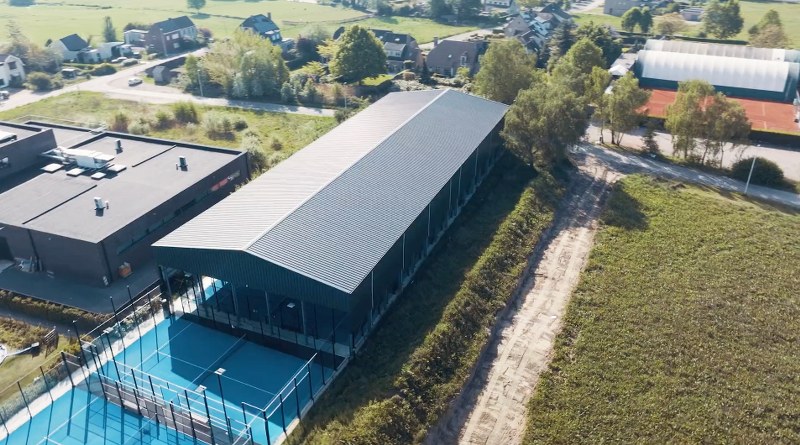
The choice between indoor, outdoor, and covered (canopy) padel courts has significant implications for build cost, ongoing operating economics, and revenue potential. Each option suits different sites, markets, and operational models.
Outdoor padel courts
Outdoor courts have the highest capital cost, with a standalone panoramic court including installation typically costing between £55,000 and £75,000. Court lighting is essential for evening play and is often included as part of the installation.
The main trade-off is weather dependence. Unlike indoor facilities, outdoor courts are affected by the UK’s climate, with heavy rain, ice, and snow reducing court availability throughout the year. On average, outdoor courts lose around 15–25% of potential playing hours due to adverse weather. Even when courts remain open, wet playing surfaces can slow the game and increase the risk of slips, reducing the overall player experience.
Canopy-covered padel courts
A canopy structure provides a significant improvement in court usability by reducing the impact of adverse weather. By protecting the playing surface from direct rainfall, snow and debris, canopies can substantially increase annual court availability compared with fully exposed outdoor courts. Depending on the design, a canopy installation typically adds £60,000 to £80,000 per court, although costs can vary based on span, materials and enclosure options.
Canopy systems are available in several configurations. Open-sided canopies provide overhead protection while maintaining a fully outdoor playing environment, maximising airflow and minimising construction costs. Semi-enclosed canopies incorporate partial side walls or windbreak panels, offering greater protection from driving rain and wind while preserving natural ventilation. At the highest specification, fully enclosed canopies combine a roof structure with complete side cladding, creating an indoor-style environment without the expense of a conventional sports building.
Fully indoor padel courts
Indoor courts require a building with sufficient height, clear spans, and floor space, so the first step is typically finding a suitable warehouse, industrial unit, or commercial building to lease or purchase. Converting an existing building is significantly more common and usually far more cost-effective than constructing a purpose-built facility. Key considerations include ceiling height (recommended 8–10 metres or more), structural columns, access, parking, utilities, and local planning requirements.
Purpose-built indoor facilities remain an option but involve substantially higher capital costs due to the building envelope and associated construction works. For most padel operators, securing and adapting an existing building offers the best balance of cost, speed, and flexibility.
Indoor courts provide the most consistent playing experience and the highest court utilisation. With no weather disruption, reliable lighting, and a controlled playing environment, operators can maximise available booking hours throughout the year. This consistency often supports higher occupancy rates, stronger membership retention, and the ability to command premium pricing, making indoor venues the most commercially attractive option in locations with sufficient demand.
Revenue implications
Indoor courts can often command higher hourly rates than outdoor courts because they offer a guaranteed playing environment regardless of the weather. In many UK markets, operators are able to charge a premium for indoor bookings, particularly during the autumn and winter months.
The biggest commercial advantage, however, is utilisation rather than pricing. Because indoor courts are unaffected by rain, ice, or snow, they can achieve significantly more bookable hours across the year, leading to higher annual revenue potential where demand exists.
While indoor courts have the potential to generate higher annual revenue, they also introduce additional property costs. Most operators lease or purchase an existing warehouse rather than build a new facility, meaning the investment profile is very different from an outdoor development. Instead of paying to construct a building, operators typically invest in fitting out the space while taking on ongoing lease, business rates, utilities, and maintenance costs. The success of an indoor venue therefore depends on maintaining strong utilisation throughout the year.
Ultimately, the business case depends on local demand, occupancy rates, property costs, financing, and the ability to maintain high court utilisation throughout the year.
What we recommend
For commercial venues in urban markets, indoor or canopy-covered is usually the better economic choice. For private installations, smaller venues, or rural settings, outdoor often makes sense. For most operators starting out, canopy-covered outdoor courts deliver the best balance of cost, weather protection, and revenue potential.
Take a look at our revenue calculator for estimates on what your court could achieve or Speak to our team for tailored advice on the right configuration for your project.